


“Most people don’t really see, they simply think.”
-Anthony de Mello, Awareness
September 2008
It was my first day in New York City.
Late afternoon in Midtown, somewhere near Rockefeller Center. The air was hot and muggy, the kind of thick summer I wasn’t prepared for. The evening commute had started, and the city hummed. Underneath it all, the unmistakable smell of the city in summer. Garbage, exhaust, and heat rising off the pavement.
My sister and her husband had helped me move, and we had tickets to the Top of the Rock to celebrate. I was navigating, so I walked like I belonged. Projected confidence I didn’t have.
I was watching the lights, not the cars.
I stepped off the curb the moment the signal changed. What I didn’t see was the pothole right in front of me. My ankle twisted. I stumbled forward into the street. And a car that hadn’t quite stopped yet was suddenly much closer than it should have been.
That’s when I heard it. A voice from the curb, loud and clear over the traffic. A homeless man was watching the whole thing unfold.
“Watch the cars, not the light. Nobody ever got run over by the light.”
I jumped back to the curb. Yelled, “Thank you!” without even seeing his face clearly. His voice held the kind of hard-earned wisdom you don’t argue with. The three of us stood there for a moment, equal parts relieved and stunned.
We quoted that line every time we crossed the street for the rest of the weekend.
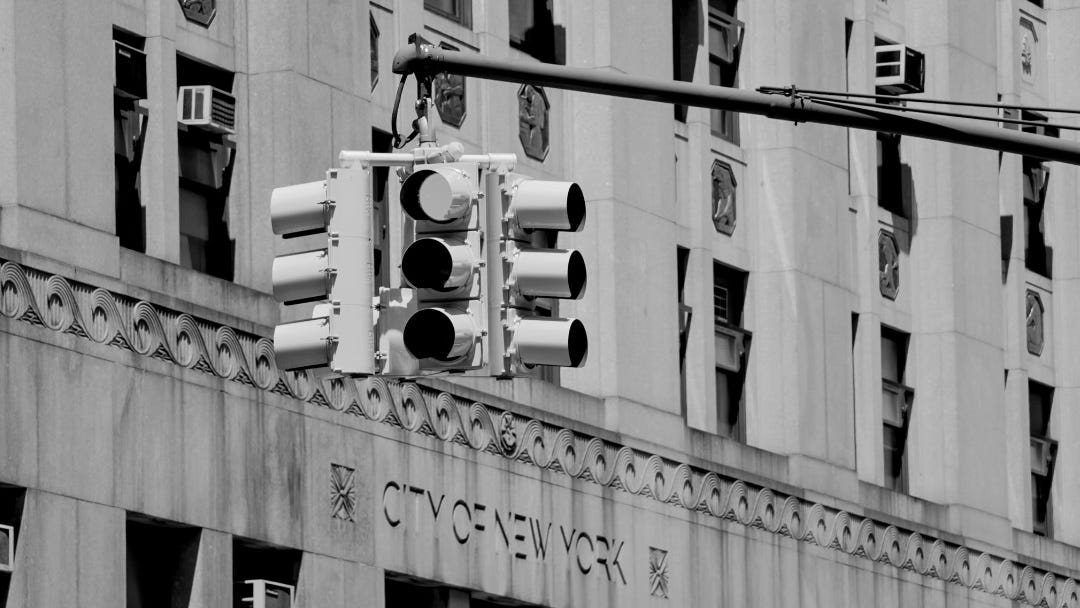
What the Light Represents
The light is the proxy. The rule. The thing we’ve been taught to trust, so we don’t have to pay attention to what’s actually happening.
Green means go. The signal says it’s safe, and we stop looking.
But the light doesn’t know about the car running late through the intersection. It doesn’t know about the pothole. It doesn’t know that you’re looking too far ahead at your destination instead of what’s directly in front of you.
The light tells you what should be true. The cars tell you what is true.
The Jesuit priest Anthony de Mello spent his life teaching people the difference. His book Awareness is built on a single premise: most of us are asleep. We move through life on autopilot, reacting to labels and rules instead of reality. We think we’re paying attention. We’re not. We’re watching the light.
Waking up, de Mello argues, means seeing what’s actually there. Not the story about what’s there or the rule that’s supposed to keep us safe. The thing itself.
A homeless man in Midtown gave me the same teaching in seven words.
Where the Compass Points
In the ENOUGH Principle, Notice means awareness before action. It’s the discipline of seeing clearly before you move.
Most of us skip this step. We react to signals instead of situations. We follow the rules without checking if they still apply.
That day in Midtown, I was doing both.
I was so focused on proving I belong in NYC that I stopped noticing what was right in front of me. The pothole. The car. The gap between the signal and the street.
Ask yourself:
Where am I looking so far ahead that I’m missing what’s right in front of me?
What “light” am I following without checking the actual conditions?
What would I notice if I stopped trusting the rules and started trusting my eyes?
What the Culture of More Gets Wrong
We’re taught that if we find the right rules and follow them perfectly, we’ll be safe.
But rules are approximations. They describe what’s usually true, not what’s true right now.
This is scarcity versus sufficiency with certainty.
Scarcity says: find the right rules, follow them perfectly, and you’ll be protected.
Sufficiency says: rules are useful shortcuts, but they’re not reality. What you see with your own eyes is what’s actually true.
A Small Practice
This week, pick one area of your life where you’ve been following a signal on autopilot. Maybe it’s a process at work or a habit at home.
Then ask: What are the cars here? What’s actually happening that the rule isn’t showing me?
You don’t have to change yet. Just notice.
That’s where every good decision starts.
See you next week.
P.S. I’d love to know: what’s a “light” you’ve been following that turned out not to match reality? When did you notice?