


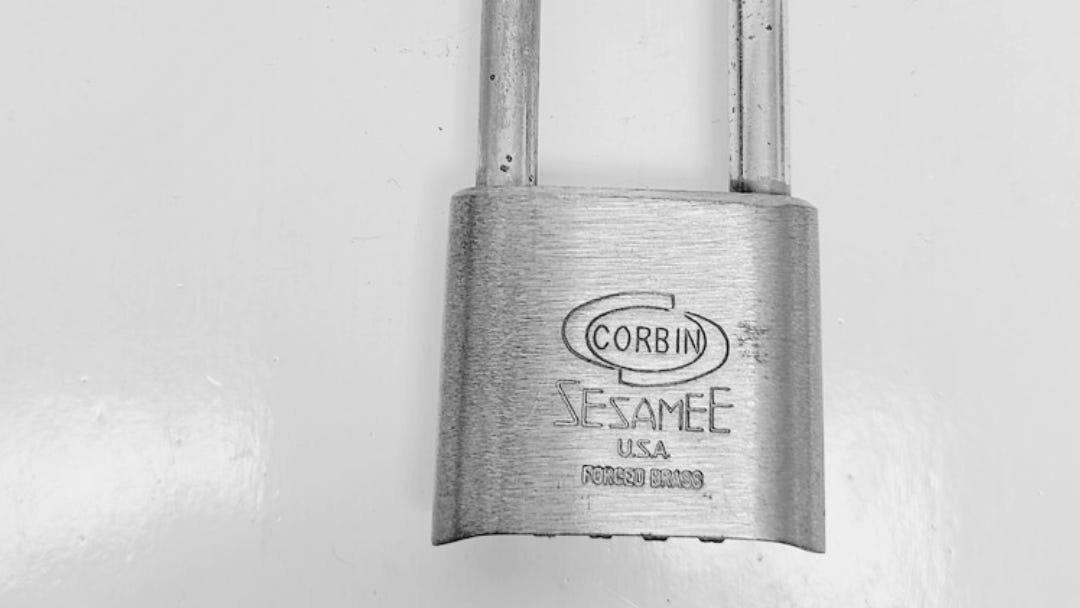
I was nine the summer we moved to Montana. My father had packed a small box of padlocks that had come from his father’s shop. My grandfather had worked at a junkyard, so we were always finding new treasures in his shop. These were big brass padlocks with four number wheels lined up along the bottom. Every single one was locked, and none of them came with a combination.
I don’t know if my dad meant to give me a project or if I just liked the challenge of figuring it out. I’d sit on the back porch, or the living room floor, and work through them one number at a time. Start at 0-0-0-0. Turn a wheel. Pull the shackle to see if it opens. Turn another. Pull again. There were five locks total, and no shortcuts. Just the same two movements, over and over, until something clicked.
The first time one actually opened, I was surprised and then thrilled after sitting with that lock for so long. My parents never asked why I was doing it. When I opened one, I handed it over to my dad, and he put it to use. One on the storage shed. One on the backyard gate.
I never opened all five. One lock beat me that whole summer. I tried again a year or two later and still couldn’t open it. Eventually I let it go, but I kept the lock itself for years after. I think I liked having a reminder that some things don’t always open just because you’re patient with them.
A Different Kind of Combination
A few years later, I was in junior high, and found a calligraphy kit in my sister’s room. It was a long-forgotten Christmas gift that she never really used. We found it cleaning one weekend, and I asked if I could try.
I loved it instantly. But I didn’t want to just write in the alphabet the kit taught. I studied the examples in the booklet, and I studied my mom’s handwriting too, the way certain letters looped or slanted, and I started pulling pieces from both. A curve I liked here. A capital letter I liked there. I practiced until the borrowed pieces stopped looking borrowed. By the end of that summer, it didn’t look like anyone’s handwriting but mine.
Thirty years later, I still write in the cursive I built that year. The locks were someone else’s puzzle. The handwriting was mine. Both required the same instinct: stay with it long enough to make something yours.
The Coordinate: Grow Curiously
In the ENOUGH Principle, Grow Curiously means you keep asking why instead of accepting the first answer you're handed. Not why in the abstract. Why this way. Why this version.
A formula hands you an answer. Curiosity asks you test one.
Scarcity says: find the proven method and follow it exactly. Someone smarter than you already worked out the fastest way. Don’t waste time reinventing what already exists.
Sufficiency says: the fastest way isn’t always the way that’s actually yours. Sometimes the version you build through trial and error fits you in a way the proven method never will.
I could have learned calligraphy exactly the way the kit taught it. Some of those locks could have just stayed locked. I wanted to find my own way through both.
A Small Practice
This week, watch for the moment you reach for a formula instead of testing your own version. A template for the email. A framework for the decision. A tutorial for the thing you could probably figure out yourself.
You don’t have to abandon the formula. Just ask, before you use it: is this the fastest way, or is it just the way I was given? Then decide on purpose, instead of by default.
See you next week.
P.S. What’s something you build through trial and error instead of following someone else’s instructions? I’d love to hear it.