


The car was hot even with the air on, one of those July afternoons where the vents blow cold, and the windshield still feels like a stovetop. My friend was driving. I was in the passenger seat, half listening to the radio, watching heat shimmer off the road ahead of us.
We hadn’t planned to talk about any of this. One minute we were talking about nothing. The next she was talking about turning fifty.
Not About the Stuff Anymore
My friend isn’t new to self-improvement. She stopped buying things she didn’t need years ago. She got free of the pressure to keep up or to prove anything through what she owned. If you met her, you’d call her someone who has her life figured out.
But that wasn’t what was bothering her. She wasn’t wrestling with stuff anymore. She was wrestling with everything the stuff used to distract her from. Fifty had put a marker down, and she was taking inventory, not of her closets, but of her life. Where she’d been and where she still wanted to go.
“I wish there was a formula,” she said, hands on the wheel, eyes on the road. “Something that just told me what enough actually feels like.”
The Answer That Fell Short
I know that frustration well. People find out I live with less and tell me some version of “I could never do that.” My answer is almost always the same: yes, you can; you just have to figure out what works for you.
It’s a good answer. It’s even true. But sitting in that car, I felt it fall short before I said a word of it. She wasn’t asking how to get rid of things. She’d already done that part. She was asking for something my usual answer couldn’t reach.
So I didn’t give it to her. I just listened. I told myself that was the gift, showing up without trying to fix it.
The Walk
I believed that for a few days. Then I went for a walk.
I do my clearest thinking on walks, the kind with no destination and no distractions. Just my feet and whatever’s been working itself out inside my brain. I was a few blocks in when it arrived, not an answer for her exactly, but a way of seeing the question that felt truer than anything I’d said in the car.
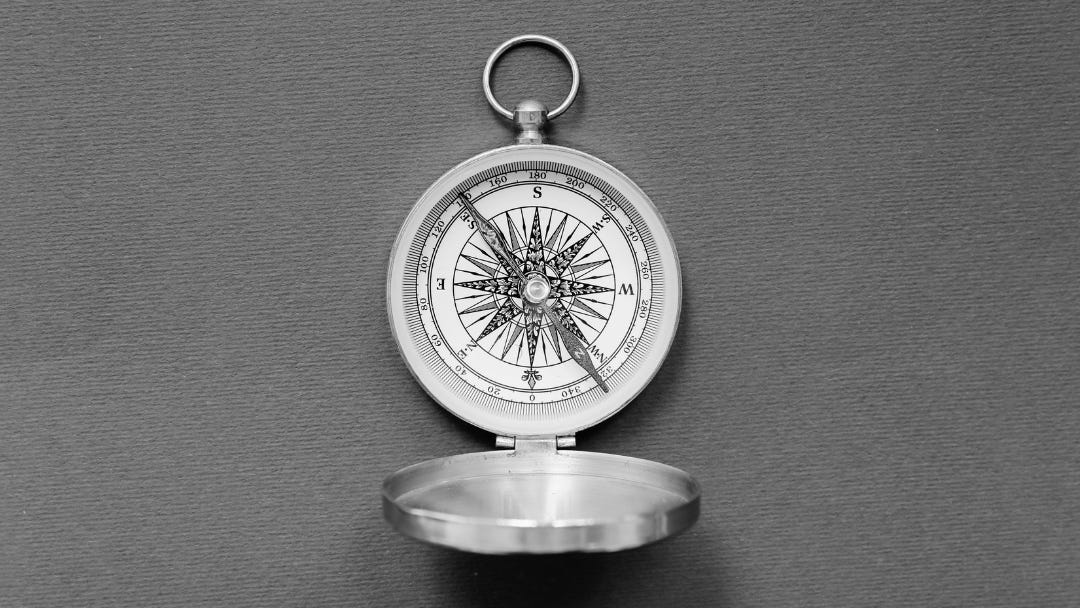
Enough isn’t a formula. It doesn’t show up on a map anyone else could hand you, and it isn’t even always visible the way a minimalist apartment is visible. Enough works more like a compass. Not the kind that points everyone toward the same fixed star, the same true north for every traveler. Enough is your own compass. It doesn’t care where anyone else is headed. It only tells you where you actually are, not where you’re supposed to end up. Sometimes they’re the same place.
What feels like your true bearing might mean packing up for someone else, or staying put for you. And what feels true today might shift in five years, because the compass isn’t broken when the needle moves. That’s not a flaw. It’s the whole reason a formula could never work in the first place.
I called her that evening and told her all of it: the compass, and the idea that her bearing was allowed to be entirely her own, and allowed to keep shifting. I don’t know if it landed the way I hoped. But I know it landed differently than ‘you just have to figure out what works for you,’ because this time I wasn’t handing her a direction. I was handing her a way to find her own.
The Coordinate: Honor What’s Yours
In the ENOUGH Principle, Honor What’s Yours means navigating by your own compass instead of somebody else’s system. Not the algorithm or the ladder someone else built and handed you to climb. A compass only works because it orients to what’s actually true for you, not to a fixed point everyone else is using to find their way. Your enough was never going to show up on a map calibrated for anyone but you.
That’s what I understood too late to say out loud in the car, but not too late to say at all. She didn’t need my formula. She needed permission to trust what already felt like north, even if north meant standing still. So I let go of having an answer, and gave her a better question instead.
By the time we hung up, she hadn’t landed on a resolution. She’d landed on a different way of finding one. Now, she had a compass to check, instead of a formula to search for.
A Small Practice
This week, catch the moment you check what’s true for you against what’s true for someone else. A book, a framework, a friend who seems to have it figured out. Don’t dismiss what they offer. Just watch for the instant you reach for their compass instead of your own.
Then ask: where does my own compass actually point right now? Not where you think it should but where it actually does.
You might be drifting toward a direction you chose a while ago and stopped checking. You might be standing still on something you haven’t looked at in years. Either way, don’t rush to fix it. Just stay with what’s true.
See you next week.
P.S. Where does your compass point to right now, and has it shifted recently?