


“I saw the angel in the marble and carved until I set him free.”
— Michelangelo
It was near closing time at the Louvre when I first stood in front of the Winged Victory of Samothrace.
The crowds had thinned. I had the sculpture entirely to myself.
She stands at the top of a long staircase, carved from white marble, over nine feet tall. Her head is missing. Her arms are gone. She has survived two thousand years, and she is incomplete by every measurable standard.
And yet she holds the space around her like she owns it.
Her tunic is carved to look wind-blown, the marble rippling as though caught mid-gust. She is frozen at the moment of landing from flight. Your mind fills in the rest. The sound of wings, the rush of air, and the movement that isn’t there but somehow is.
I stood at the bottom of the staircase and looked up.
A Greek sculptor had made her two millennia before. Whatever he felt carving that moment, the suspension or the life caught mid-breath, I felt it standing there alone at closing time. Transmitted through stone.
I didn’t think about what was missing. I felt the wind.
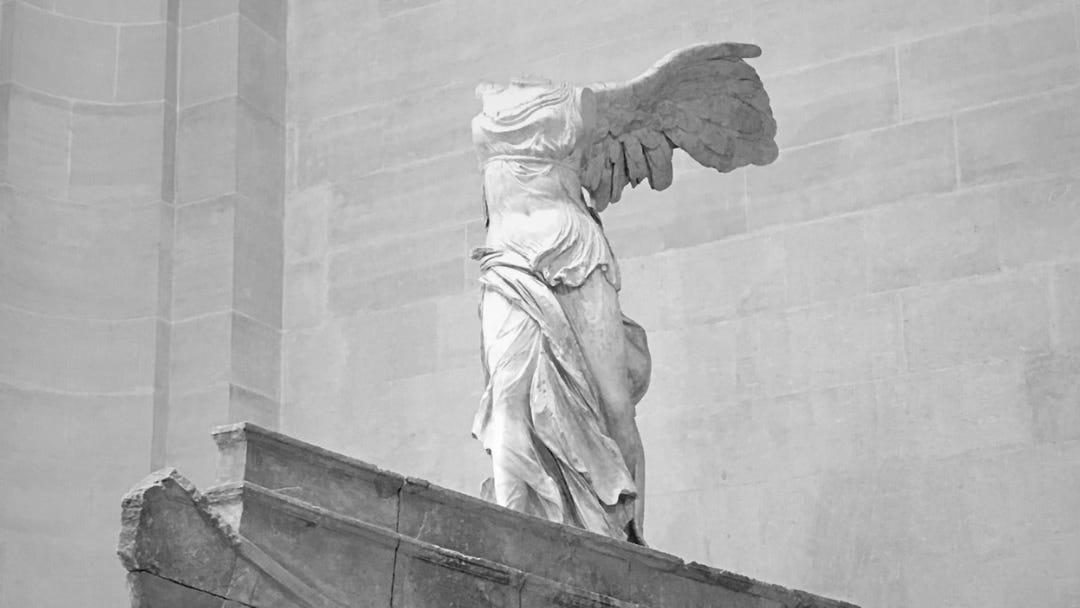
What the Sculptor Removes
That’s when I understood something about what sculpture actually is. Not what the artist adds. What they take away.
Michelangelo said he saw the angel in the marble and carved until he set it free. He didn’t build the angel. He found it. The figure was already inside the block of stone. His job was removal, chip by chip, until what was always there finally became visible.
A few years later, I stood in front of the David in Florence. I had been first in line when the Galleria dell’Accademia opened, and had a few minutes with the statue before anyone else arrived. I walked the entire circumference of it, taking in each detail. The tension in his hands and the weight of his gaze.
I kept thinking about the stone on the floor. All that material that had to go so the figure could emerge.
David isn’t what Michelangelo added. David is what he was willing to remove.
Nine Years of Marble
By 2018, I had spent nine years adding.
Titles and achievements. A calendar that didn’t feel like my own and a strategy I didn’t believe in. I had been layering things on top of myself for so long that I had started to forget what was underneath.
I moved to New York City in 2008 to write and do stand-up comedy. Somewhere in the promotions and the performance reviews, I had covered that person over almost completely. Not on purpose. But with one reasonable trade at a time. Always telling myself I’d get back to it.
By the time I was staring at a cold-call deck I had no belief in, I knew I wasn’t building anything. I was adding more marble over something that was already there.
I took my first sabbatical in 2018. The work that followed was removal.
I removed the job and the schedule. The version of success I had been performing for over a decade. And slowly, what had always been there started to become visible again. The writer and the comedian. The person who had packed up her life and moved to NYC because she had something to say.
All of it was waiting underneath everything I had piled on top.
The Coordinate: Undo
In the ENOUGH Principle, Undo means release what no longer fits.
But Michelangelo points to something deeper than letting go. He points to the recognition that what you’re looking for was already inside.
The work of undoing is revelation. You chisel away to find what was already there.
Ask yourself:
What have you been adding to yourself that might actually be covering something that’s already there?
What version of yourself existed before the accumulation began?
What would become visible if you stopped trying to build and started removing instead?
What the Culture of More Gets Wrong
We treat growth as addition. More accomplishments layered on top of more accomplishments. More layers between who we are and who we think we’re supposed to be.
This is scarcity versus sufficiency with identity.
Scarcity says: keep adding. The right combination of credentials will eventually make you into the person you want to be.
Sufficiency says: the person you’re looking for is already in the marble. The work isn’t building. The work is carving.
A Small Practice
This week, instead of asking what you need to add to your life, ask what you might remove.
Not the dramatic things. Just one small layer. One commitment maintained out of habit or a role you’ve been performing that isn’t quite yours anymore.
The Winged Victory lost her head and arms, and she still commands the room.
You don’t need to be complete to be whole.
See you next week.
P.S. I’d love to know: what’s something you’ve been adding to yourself that might actually be covering something that was already there?