


“I’ve always been crazy, but it’s kept me from going insane.”
— Waylon Jennings
Somewhere on a two-lane highway in Montana, a cassette tape changed the way I understood the world.
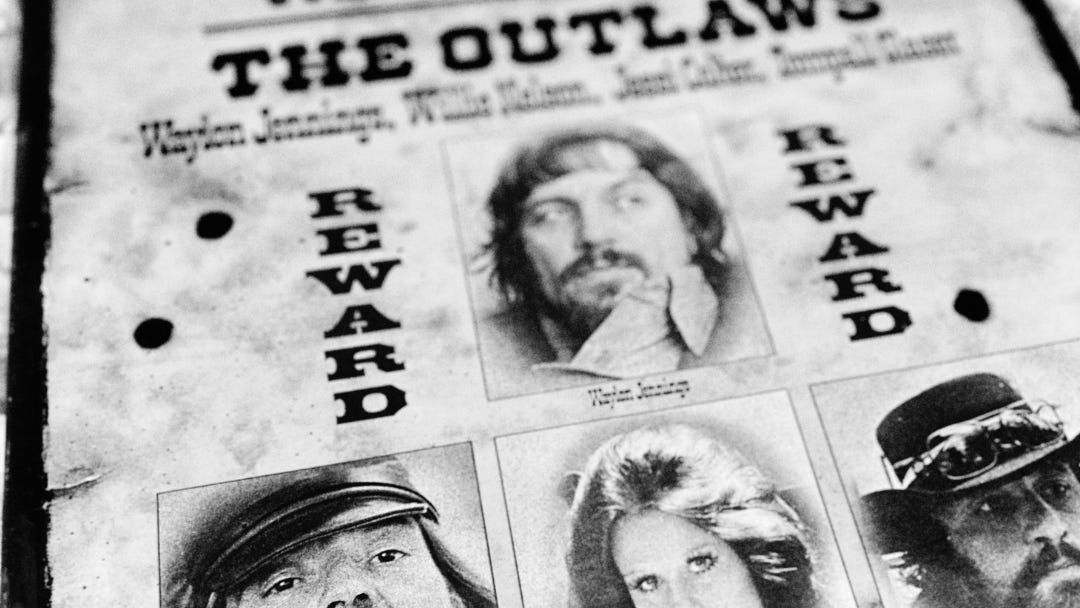
I don’t remember the exact summer or the grade I was in. What I remember is the feeling. My family packed into the car, headed somewhere with trees and water and no particular agenda. Music was always part of the road. My mom had her Creedence Clearwater Revival. My dad had his Marty Robbins. But this trip, someone put in Wanted! The Outlaws, and by the second song, I was asking to hear it again.
Wanted! The Outlaws was the first platinum album in country music history. I didn’t know that then. I just knew it sounded like nothing else in the car, and I was hooked.
The album cover showed the stars dressed up like cowboy outlaws. Waylon. Willie. Jessi. Tompall. To me, it looked like proof that you could go wherever you wanted, say whatever you meant, and people would love you for making your own rules.
A Stance, Not a Sound
The Outlaw Country movement was a stance. Nashville in the 1970s had a formula: polished production built for maximum radio play. Waylon and Willie looked at all of that and said no.
They took control of their own recordings and wrote what they meant. Their audience was starved for something real. As a kid in Montana, all I knew was that the rule-breakers were the ones everybody remembered. Their authenticity is what people loved.
I became a Waylon fan after that road trip, chasing down every album I could find. One of them held the line that said it plainest: I’ve always been crazy, but it’s kept me from going insane. The safe path is the risky one. It’s the one that slowly asks you to become someone else.
Saturday Nights
When I was a kid, my family watched Hee-Haw together every Saturday night. If you’ve never seen it, the format sounds almost impossible: cornfield jokes, country music, Minnie Pearl in a hat with the price tag still dangling, and then a singer who could make the whole room go still. Comedy and music sharing the same stage, passing the emotional baton back and forth.
I had no idea I was studying it. I just knew I never wanted to miss it.
Minnie Pearl could make a crowd laugh so hard they were gasping, and then Roy Clark would pick up a guitar and take everyone somewhere completely different. Two entirely different crafts, working by the same principle: the right word, in the right place, at the right moment.
When I Started Writing Jokes
Years later, when I started performing stand-up comedy, I did what most new comics do: I studied the people I admired. George Carlin. Redd Foxx. Rodney Dangerfield. Dave Attell. But I also kept studying songwriters.
What I noticed was structure. A great country lyric earns its last line. Every word before it is load-bearing. Nothing is wasted. When I started writing my own material, my jokes looked strange on the page. More like poems than punchlines, laid out in lines that tracked the rhythm of the thought. I was building jokes the way Waylon built songs. Economy first, with feeling carried by precision.
The same instinct followed me off the page. Moving to a big city to chase stand-up. Living with 132 things when everyone else was accumulating more. Leaving stable careers when something essential was being asked of me that I wasn’t willing to give. From the outside, most of it probably looked crazy.
But the Waylon line kept proving true. The crazy choices kept me from the particular insanity of becoming someone I didn’t recognize.
Where the Compass Points
In the ENOUGH Principle, Honor What’s Yours means navigating by your own compass.
It doesn’t mean ignoring craft. The Outlaws worked harder on their music, not less. It means knowing which standards are yours to uphold, and which ones were handed to you by a system that benefits from your conformity.
Ask yourself:
Where are you following a formula that was never built for you?
What have you been calling “crazy” that might actually be your clearest signal?
What would your work look like if you trusted your own instincts the way the Outlaws trusted theirs?
What the Culture of More Gets Wrong
We’re taught that credibility comes from conformity. Follow the proven path and use the accepted format. Look like what success is supposed to look like.
This is scarcity thinking applied to identity.
Scarcity says: fit the mold first, find yourself later. The market rewards what’s familiar.
Sufficiency says: the most durable thing you can offer is a genuinely distinct point of view. You can’t manufacture that. You can only protect it.
The Outlaws knew this. So did Minnie Pearl. They weren’t waiting for permission to be themselves. They’d already decided that was the only game worth playing.
A Small Practice
This week, pick a song, an essay, a joke, or a business you genuinely admire. Then ask: what rule did this person refuse to follow? Then ask: what rule are you still following that you haven’t examined in a while?
You don’t have to break it today. Just see it clearly. The Outlaws didn’t burn Nashville down. They just stopped letting it decide what they were worth.
See you next week.
P.S. I’d love to know: what’s a piece of music or art that gave you permission to see the world differently? What did it unlock for you?