


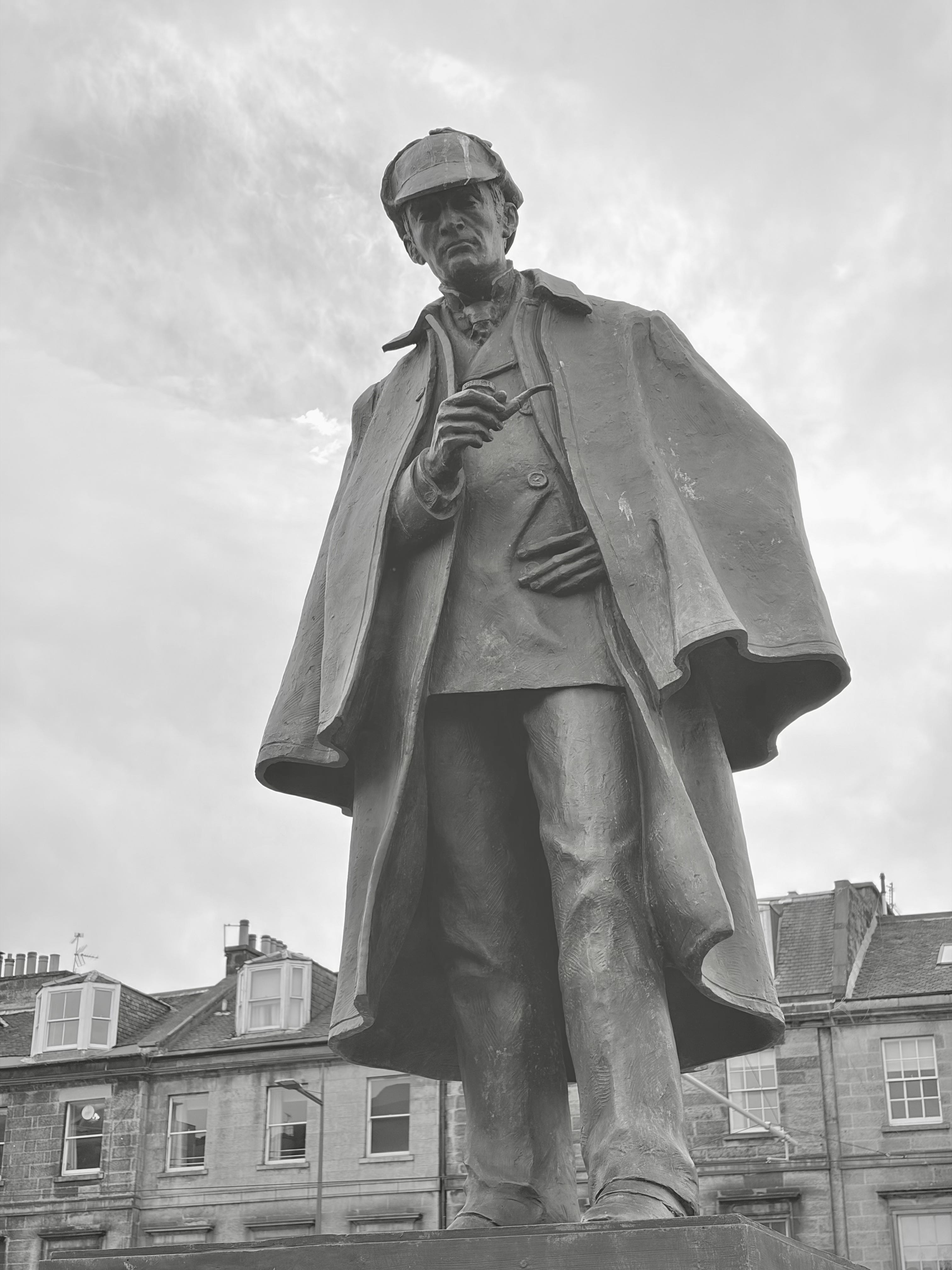
On my last night in Edinburgh, I planned a special detour to find the Sherlock Holmes statue in New Town on the way to dinner.
He’s bronze and taller than life, set on a stone base in Picardy Place, near where his creator, Arthur Conan Doyle, was born in 1859. The house itself is long gone. What remains is the detective, holding his pipe and keeping watch while the city moves around him.
I looked up at that familiar profile, and for a moment I was back in my elementary school library.
The book I found there had a deep green cover with the same silhouette on the front: hat, pipe, and a long nose pointed at something just out of frame. It was old and beat-up, the kind of book that had clearly passed through many hands before it reached mine.
I was deep in a mystery phase. Nancy Drew, Encyclopedia Brown, anything with a case to crack. I read anywhere I could find a spot, and I always tried to solve the mystery before the detective did. Encyclopedia Brown turned that into a game. The solutions were printed in the back, and when you checked, the answer usually hinged on some small detail you’d read right past.
Sherlock Holmes put the whole idea into one sentence I’ve remembered ever since:
“It has long been an axiom of mine that the little things are infinitely the most important.”
Waiting for the Verdict
What I didn’t know as a kid is that Holmes was born in Edinburgh too, in a way. Conan Doyle studied medicine there and worked under a surgeon named Joseph Bell, who was known for diagnosing patients through close observation. Conan Doyle took that habit and built a detective around it.
Standing in front of a monument to paying attention, I thought about how much of my life since that green book has gone into waiting for the big things: the milestone, the promotion, the moment someone finally tells me I made it. Until that verdict comes in, the case stays open, and an open case starts to feel like proof you’re not there yet.
This is how scarcity keeps you chasing. It promises that enough will be obvious when it arrives, so you keep scanning the horizon for the big announcement and walk right past the evidence already sitting in the room.
Seventeen Steps
In “A Scandal in Bohemia,” Holmes asks Dr. Watson how many steps lead up to their rooms at Baker Street. Watson has climbed them hundreds of times and has no idea. There are seventeen. “You see, but you do not observe,” Holmes tells him.
Watson is a smart man. His attention simply goes where most attention goes, toward whatever is new or out of place. The familiar fades into the background. Psychologists call this habituation, and it’s useful because it frees your mind to notice what might need you. It also means the good things that show up every day slowly become invisible because they keep showing up.
Sufficiency reads the case the way Holmes did, building it from the mud on a boot and the wear on a sleeve. Enough rarely arrives as a verdict. It accumulates as evidence.
Opening a Case File
The method is simple enough to fit on an index card. Once a day, write down one piece of evidence that today was enough. Two rules keep it honest.
First, observe instead of just seeing. “Had a good day” is seeing. “The autumn leaves in my backyard lined up red, yellow, and green” is observing. Make it specific enough that a detective could verify it.
Second, leave the verdict out. Write down what happened and leave it without a ruling on what it means. You’re gathering evidence, and the case builds itself.
A Small Practice
Tonight, before bed, write down one small thing from today that was already enough. Then do it again tomorrow.
Somewhere in Edinburgh, a bronze detective still keeps watch over the little things.
See you next week.
P.S. What’s one small piece of evidence from your week? Hit reply and tell me what’s in your case file.